



By Sumaila Ogbaje
The National Security Adviser (NSA), Malam Nuhu Ribadu, has said that illicit small arms and light weapons remained the lifeline of terrorism, banditry, kidnapping and other violent crimes threatening Nigeria’s security.
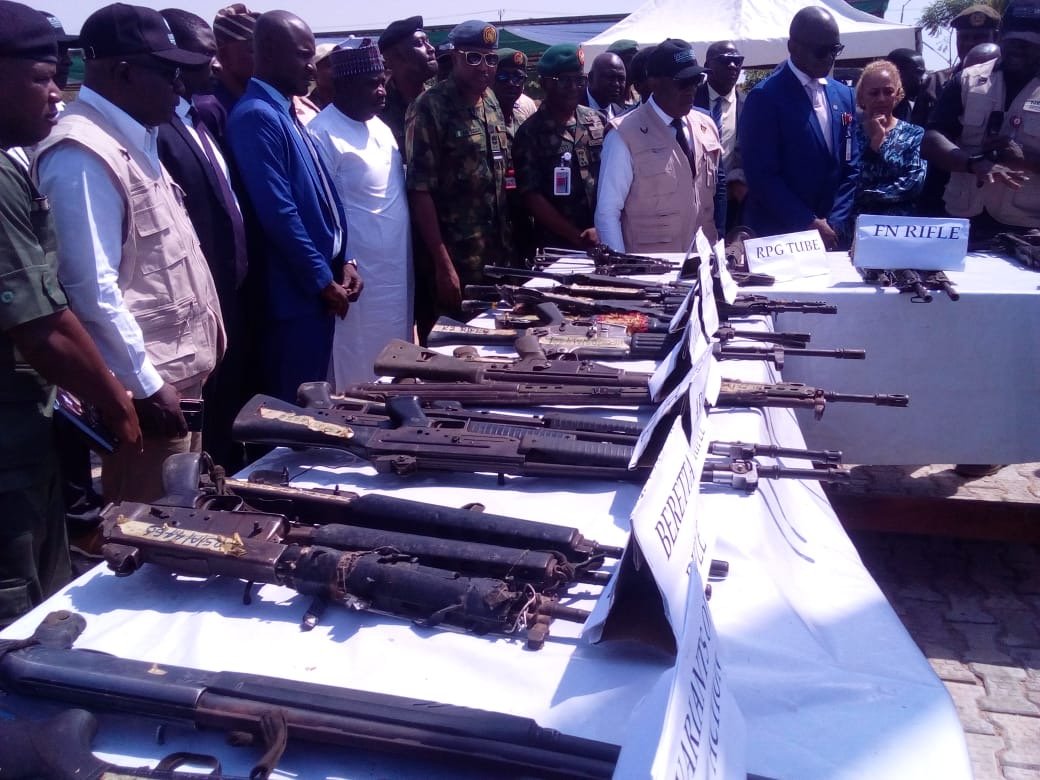
Ribadu stated this on Wednesday in Abuja at the public destruction of about 1,000 illicitly acquired, decommissioned and unserviceable small arms and light weapons.
He was represented by the National Coordinator, National Counter-Terrorism Centre (NCTC), Maj.-Gen. Adamu Laka, at the event organised by the National Centre for the Control of Small Arms and Light Weapons (NCCSALW).
The NSA said the availability of illegal weapons had continued to sustain criminal networks, fuel violent conflicts and undermine security efforts.
He warned that their proliferation must be tackled as a critical component of the country’s counter-terrorism strategy.
He said the connection between illicit arms proliferation and insecurity was direct and unmistakable, stressing that denying criminal groups access to weapons was essential to degrading their operational capabilities.
“Terrorism, insurgency, banditry, kidnapping and communal conflicts are all sustained by the availability of illegal weapons.
“Every weapon recovered by our security agencies and eventually destroyed, represents a threat permanently neutralised,” he said.
Ribadu warned that recovering illegal weapons without ensuring their proper documentation, storage and eventual destruction could create opportunities for them to return to criminal networks.
He said the Federal Government, under President Bola Tinubu, was pursuing a comprehensive security strategy anchored on intelligence-led operations, inter-agency collaboration, disruption of criminal and terrorist financing networks and strategic engagement with international partners.
“However, recovery alone is not enough. Weapons that are seized but poorly treated, stored or accounted for risk re-entering circulation.
“Public destruction, as we witnessed today, closes that loop decisively and ensures that these weapons can never again threaten our citizens.
“These efforts have contributed to degrading terrorist networks and strengthening Nigeria’s national security architecture,” he said.
The NSA also highlighted the importance of international cooperation in addressing the sources and financing of illicit arms trafficking, commending the NCCSALW for strengthening collaboration with the Ministry of Foreign Affairs.
He said the diplomatic initiative was important in identifying and disrupting external sources of illicit weapons and their financing into Nigeria.
Ribadu further described the destruction of illicit weapons as complementary to ongoing military and security operations, noting that sustained efforts to reduce weapons availability would weaken the capacity of terrorists, insurgents and other criminal elements.
He urged Nigerians to support security agencies with timely and credible intelligence on the illegal possession, manufacture and movement of firearms.
“Security is not the responsibility of government and its agencies alone. It requires a whole-of-society approach involving communities, traditional and religious institutions and ordinary citizens,” he said.
He particularly urged traditional and religious leaders to use their influence to promote peace, tolerance and peaceful coexistence, while addressing conditions that expose young people to recruitment by armed groups.
Earlier, the Director-General of NCCSALW, retired DIG Johnson Kokumo, disclosed that the Centre had so far recovered over 22,377 illicit weapons and destroyed more than 18,000 since its establishment.
Kokumo described the exercise as a practical and irreversible contribution to national security, insisting that every destroyed weapon represented one less instrument available to criminal elements.
“Every weapon that goes into the furnace today is a weapon that can never again be used to threaten a community, terrorise innocent citizens or facilitate criminal and terrorist activities,” he said.
He disclosed that the Nigeria Police Force had contributed the largest share of firearms destroyed under the programme, with 11,907 weapons recovered through police operations across the country.
The DG commended the Armed Forces of Nigeria, Department of State Services, Nigeria Customs Service and other security and intelligence agencies for their collaboration in recovering and surrendering illicit weapons for destruction.
He said the ’entre was also expanding its collaboration beyond Nigeria’s borders to address external sources and channels through which illicit weapons enter the country.
Kokumo reaffirmed the Centre’s commitment to working with relevant national and international partners to curb illicit arms proliferation and strengthen Nigeria’s security architecture. (NAN)
Edited by Sadiya Hamza