



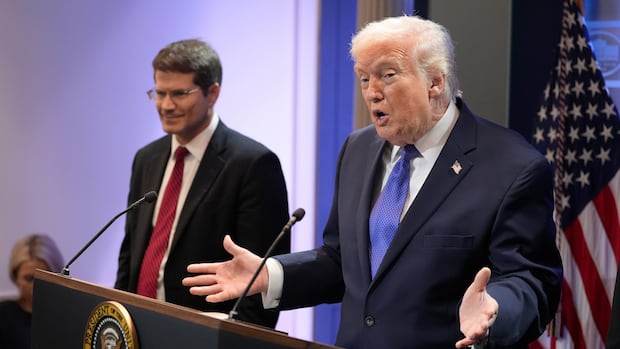
After imposing a global tariff of 10 per cent following a stinging loss at the U.S. Supreme Court, President Donald Trump now says he’s raising that rate an additional five per cent — though exemptions for CUSMA-compliant goods from Canada and Mexico still apply.
On Friday, the U.S. Supreme Court struck down the tariffs Trump implemented using a 1977 law called the International Emergency Economic Powers Act (IEEPA).
In response, the U.S. president turned to Section 122 of the U.S. Trade Act to impose the new global tariff. Trump said on social media Saturday morning that he’s raising that tariff to 15 per cent after a “thorough, detailed, and complete review” of the court decision.
“During the next short number of months, the Trump Administration will determine and issue the new and legally permissible Tariffs, which will continue our extraordinarily successful process of Making America Great Again,” Trump said on his Truth Social platform.
Section 122 allows temporary tariffs of up to 15 per cent — but these tariffs can only be imposed for 150 days unless Congress approves an extension.
WATCH | Trump signs order imposing new global tariff of 10%:

U.S. President Donald Trump posted on social media that he signed an order to impose the tariff on imports from all countries, which will be ‘effective almost immediately,’ after other levies were struck down by the U.S. Supreme Court. Canadian exports to the U.S. that comply with CUSMA will be exempt from these tariffs, according to a fact sheet posted by the White House.
Trump’s latest declaration is unlikely to meaningfully affect Canada. A fact sheet from the White House distributed on Friday night says goods that are compliant with the Canada-United States-Mexico Agreement (CUSMA) are exempt from the president’s latest duty.
Still, other sectoral tariffs are still in effect. Trump has used Section 232 of the U.S. Trade Expansion Act to impose levies on Canadian steel, aluminum, copper, some automotive parts, lumber and other wood products.
Section 232 of that act allows top U.S. officials to direct the secretary of commerce to look into suspected national security threats caused by imports. Within 270 days — roughly nine months — the secretary must present the president with a report and any recommendations for action.
The use of Section 232 tariffs was not addressed in Friday’s court decision. The Supreme Court ruled only on the IEEPA tariffs.