



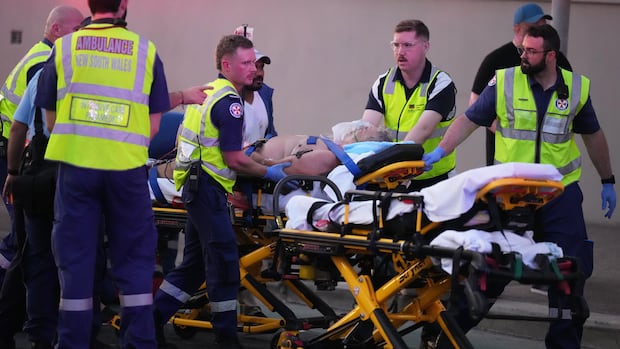
The two men alleged to have carried out the deadly mass shooting at Sydney’s Bondi Beach could have been inspired by ISIS or have received actual training to help carry out the attack, experts of the militant group say.
“I began thinking this might have been ISIS-inspired. I’m now thinking it could have been either ISIS-enabled or ISIS-directed,” said counterterrorism analyst Colin Clarke of Sunday’s attack, which left 15 people dead at a Hanukkah celebration.
The suspects were a father and son, aged 50 and 24, authorities have said. The older man, whom state officials named as Sajid Akram, was shot dead by police. His son, identified as Naveed Akram, was wounded and remains in hospital, having emerged from a coma on Wednesday.
They allegedly fired upon hundreds of people for roughly 10 minutes at the popular tourist destination, forcing them to flee and take shelter.
Both travelled to Philippines
Police say a vehicle found at the scene, which is registered to the younger suspect, contained improvised explosive devices and two homemade flags associated with ISIS.
Australia’s federal police commissioner Krissy Barrett said later that the shooting was “a terrorist attack inspired by Islamic State.”
Meanwhile, the suspects’ recent trip to the southern Philippines, known to be a home for ISIS-related groups, has raised more speculation about their links to the militant group.
Clarke, who heads the New York-based security think-tank the Soufan Center, says the way one of the two gunmen fires his weapon, as seen in videos of the attack, makes it clear he had training.
“This guy was not an amateur,” he said.
However, the dead suspect, Sajid Akram, was a licensed gun owner and belonged to a gun club, police said.
Clarke says the ISIS flags, along with the discovery of IEDs, are “all the hallmarks of a classic ISIS attack.”
WATCH | Mourners flock to site:

Australia’s prime minister said a mass shooting at a Hanukkah celebration at Bondi Beach appears to have been motivated by ISIS ideology. Meanwhile, mourners flocked to the site to lay flowers and grieve for the people killed, including a 10-year-old child.
Bruce Hoffman, a senior fellow for counterterrorism and homeland security at the Council on Foreign Relations, says random attacks ISIS has launched in the past makes it “100 per cent plausible” the group was involved.
“The fact that the flags are found in their car, it almost becomes a moot point. I mean, it’s clearly they situated that violence within an ISIS framework.”
“The question is, how closely linked to ISIS were they?” he said. ”Was this a command-and-control operation?” — meaning, were the assailants acting on direct orders from the group?
But the bigger question, he says, is how and when they were radicalized.
Philippine immigration officials say both men travelled to Manila and onward to Davao in the south of the country on Nov. 1 and left on Nov. 28, just weeks before the Bondi shooting. But they have said none of that is conclusive that they were linked to a terrorist group or received training in the country.
Groups of Muslim separatist militants, including Abu Sayyaf in the southern Philippines, once expressed support for Islamic State and have hosted small numbers of foreign militant combatants from Asia, the Middle East and Europe in the past.
Decades of military offensives, however, have considerably weakened Abu Sayyaf and other such groups, and Philippine military and police officials say there has been no recent indication of any foreign militants in the country’s south.

Both Hoffman and Clark agree that ISIS-linked branches in southeast Asia have been significantly weakened in years.
Yet the remnants are still powerful enough to provide individuals and small cells with the training and logistical support needed to curry out lethal terrorist attacks, Clarke says.
“I think that’s what we’re looking at here,” he said. “The Filipinos have done a good job at beating back a lot of that threat, but again, it hasn’t been fully [reduced.]”

‘Fingerprints could be all over this’
Clarke says ISIS could have assisted with training and target selection.
“They could have helped pick the Hanukkah event on the beach. They could’ve pushed [the suspects] to consider building IEDs. They could have told them to include the homemade ISIS flags. We just don’t know.”
“Their fingerprints could be all over this.”
Clarke, who studies and tracks ISIS, says these potential links are a reminder that ISIS, while a weakened force, still poses a threat.
“This threat is still very much in play,” he said. “They’ve gone back to old-school terrorism, classic terrorism, guerilla tactics. They’re still able to go into a public place in the West and kill civilians, whether they’re inspiring people to do it in their name, or they’re training and dispatching people themselves.”
In recent years, ISIS-related groups have launched a series of deadly attacks. Hoffman says ISIS likes to strike at “unexpected places” which have included Sri Lanka on Easter Sunday in 2019, attacks in Iran, Istanbul and Moscow in 2024, and the New Orleans attack in January 2025.
He says ISIS hasn’t stopped, even though Western powers weakened it by defeating its governing capacity in Iraq and Syria and destroyed its caliphate in 2019.
“They may be down, but they’re not out, and they’re still interested in carrying out attacks.”