



For decades, Iran has wrapped itself in a security blanket that’s covered much of the Middle East. A network of well-funded, heavily armed and deeply radicalized militant groups, designed to protect the centre of the Shia Muslim world. A shield for the Iranian revolution.
Except now, just as Iran needs this so-called Axis of Resistance most, it seems to have melted into an axis of reluctance. Groups from Yemen to Syria to Iraq are staying on the sidelines. Gaza’s Hamas has few options.
Only Hezbollah, Iran’s first and biggest proxy, seems to be helping out, firing rockets and drones from Lebanon into Israel, its leader Naim Qassem vowing “we will not surrender no matter the sacrifices.”
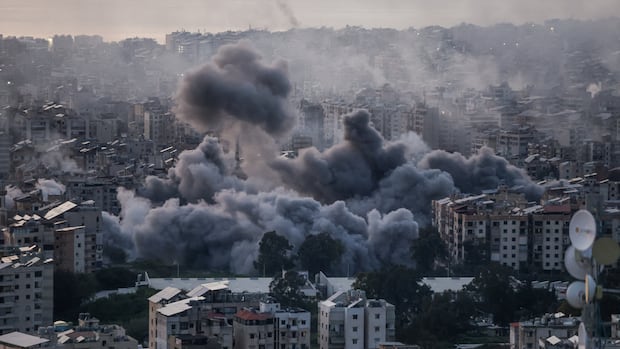
Those sacrifices are being felt from the border to Beirut, as Israel responds with days of crushing airstrikes, ordering civilians to empty dozens of villages. Israel says it has targeted 500 Hezbollah sites. More than 200 people have been killed, according to the Lebanese Health Ministry.

Hezbollah’s involvement met with outrage
Thousands have been left homeless, not knowing who to blame more — Israel or Hezbollah. “Both of them are oppressing us as Lebanese,” said student Sara Moussalli in Beirut.
Hezbollah has a huge military and political presence in Lebanon, but its decision to get involved has been met with outrage. The government has declared all of its military actions illegal.
“Why embark on a suicidal operation,” Beirut’s L’Orient-Le Jour daily newspaper asked of Hezbollah in a recent editorial, noting it was costing Lebanon “so dearly, when it is not even in a position to save its Iranian patron.”
WATCH | Saša Petricic explains why Iran may be forced to go it alone in this conflict:

The U.S. and Israeli war against Iran shows no signs of stopping, with Iran’s key allies noticeably absent as fighting pushes the one-week milestone. Senior foreign correspondent Saša Petricic explains why Iran might be forced to go it alone when attacking Israel, the U.S. and their allies in the Middle East.
The militant group was badly weakened after more than a year of air attacks and even an Israeli ground invasion, triggered when Hezbollah fired rockets into northern Israel at the outset of the Gaza war. Its leader Hassan Nasrallah was assassinated by Israel in an airstrike in September 2024.
Indeed, since the war in Gaza started in October 2023, Israel has killed many Mideast proxy leaders — as well as the Iranian officials directing them — through targeted strikes in Syria, Yemen, Qatar, Lebanon, Gaza and Iran.
The Axis of Resistance was “clobbered,” said Thomas Juneau, an international affairs professor and Middle East expert at the University of Ottawa.
In the past, “a rough balance of power guaranteed some kind of fragile but mutual deterrence” between Israel and the U.S. on one side, and Iran and its axis on the other, he said. But after Oct. 7, 2023, Israel “rejected constraints.”
Houthis offer words of support
The threat of more attacks by Israel and the U.S. also seems to have subdued the Houthis in Yemen. They became notorious for attacking ships passing through the Red Sea from 2023 through 2025, retaliating, they said, for Israel’s actions in Gaza. They also fired missiles and drones at Israel itself, more than 2,000 km away.
This week, their leader was only firing off threats.
“With hands on the trigger,” Houthi leader Abdul Malik al-Houthi vowed support for Iran. “We are prepared to take action at any moment, should developments require it.”
Hardliners want more action, said Yemeni conflict analyst Hisham al-Omeisy in a social media post. Not so much to help Iran, he said, but to “capitalize on the moment and assert [the Houthi] position.”

There seems to be less interest in fighting in Iraq as well. That’s partly because some militant leaders have moved into government positions, including becoming members of parliament, and they don’t want to see Iraq drawn into the conflict.
“But many are just looking out for their own interests these days,” instead of dying for Iran, a paramilitary group military commander who goes by A.J. told Reuters.
No more help from Syria
The axis wasn’t helped by the fall of Bashar al-Assad and his Syrian regime in late 2024.
Assad was close to Iran, with Tehran using Syria as a base for militant groups and as a supply route for fighters and weapons to reach Lebanon.
Now, Syria is in the hands of Ahmed al-Sharaa, a former leader of the rebel Sunni group, the al-Nusra front. Hostile to Iran, he kicked out Iranian and Hezbollah forces when he took over.

All of that does seem to leave Iran more isolated and vulnerable than ever.
But it could still be part of a strategy, warned Rosemary Kelanic, director of the Middle East program at the Defense Priorities think-tank.
“It’s possible the Houthis are being kept in reserve,” she said, as part of a “back pocket plan” that could be implemented to disrupt Red Sea shipping once again if Iran wants to put more pressure on its enemies.