



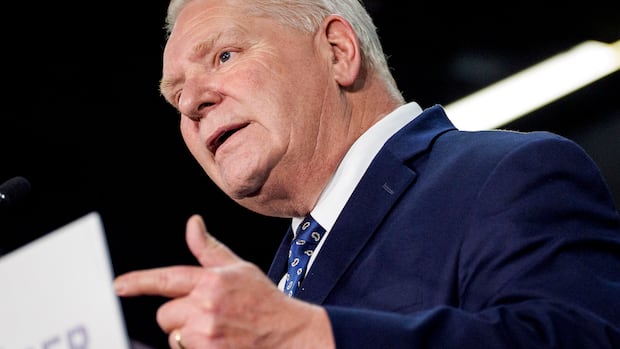
Ontario Premier Doug Ford says he’s happy about the U.S. Supreme Court’s decision to strike down a number of tariffs President Donald Trump has imposed in his second term, but uncertainty still threatens the province and country.
On Friday, the U.S. Supreme Court struck down the tariffs Trump implemented using a 1977 law called the International Emergency Economic Powers Act.
In response, Trump turned to Section 122 of the U.S. Trade Act to impose a new global tariff. Initially stating it would be 10 per cent, Trump said on social media Saturday he’s raising it to 15 per cent after a “thorough, detailed, and complete review” of the court decision.
Most trade between Canada and the U.S. was exempt from those tariffs as a result of the Canada-United States-Mexico Agreement (CUSMA).
WATCH | SCOTUS decision’s impact on Canada:

The U.S. Supreme Court has ruled that President Donald Trump overstepped his authority when invoking emergency powers to order tariffs last year. But now Trump is calling for a 10 per cent global tariff in response to the ruling. Douglas College political science instructor Jovian Radheshwar told BC Today that uncertainty in Canada over tariffs and trade will remain.
Speaking to reporters at Queen’s Park Monday, Ford said while some Canadian sectors still face tariffs, “It was a positive message from the Supreme Court.”
“Make no mistake about it, President Trump still has a lot of tools,” he said, referring to upcoming CUSMA negotiations and separate tariffs Trump implemented under Section 232 of the U.S. Trade Expansion Act.
“But I think the walls are closing in.”
Section 232 of that act allows top U.S. officials to direct the secretary of commerce to look into suspected national security threats caused by imports. Trump used it to impose levies on Canadian steel, aluminum, copper, some automotive parts, lumber and other wood products.
Ford continues anti-tariff messaging to U.S.
Ford repeated the comment later Monday while speaking with the American broadcast news outlet CNN. He told host Wolf Blitzer that Trump’s trade war with Canada was impacting pocketbooks and jobs on both sides of the border, and that businesses in both countries “need certainty.”
Ontario Chamber of Commerce president and CEO Daniel Tisch says the U.S. Supreme Court’s recent decision doesn’t necessarily change much for Ontario businesses in the short-term, but provides more stability by reigning in the whims of the presidency.
“Of course, Trump hates this kind of thing because he loves the unpredictability, but business hates it, and it’s been destabilizing business in both the U.S. and Canada,” he told CBC Radio’s Metro Morning Monday.
Tisch said he believes there is bipartisan support in the U.S. Congress for free trade with Canada, while Ford told reporters Monday that he “can’t wait for the [U.S.] midterms” in light of the decision.
Ford said he’s been encouraging other Canadian premiers to contact American legislators and emphasize the uncertainty he says Trump is creating for both countries, adding that he plans to travel south to meet with state governors in the coming months.
In the meantime, he said Ontario would continue work to diversify trade beyond the U.S., and to attract businesses and investment to the province. He said his government is focusing on sectors like nuclear, manufacturing, health care, skilled trades and mining.