



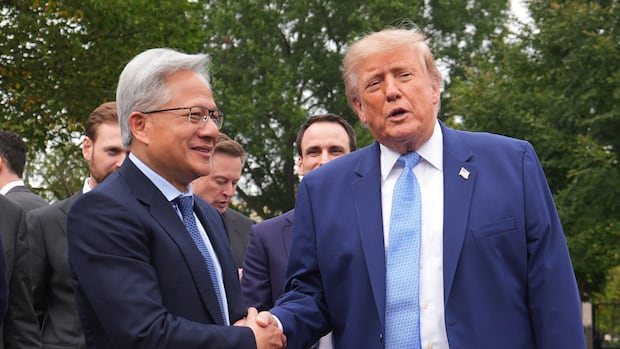
U.S. President Donald Trump’s extraordinary intervention to get Jensen Huang reinstated as Nvidia CEO does little to shut down many pressing questions about a scandal that has rocked both Washington and the stock markets.
Nvidia’s about-face comes just 11 days after Huang stepped down, following allegations he’d had multiple extramarital affairs, including one with a woman reportedly suspected of spying for China.
Trump is taking full credit for persuading the board of one of the world’s most valuable companies to bring Huang back by assuring them he poses no national security risk.
“I convinced them,” Trump told CNBC in a phone interview on Monday. “I made the deal.”
That “deal” triggered a one-day jump of 30 per cent in Nvidia’s share price, effectively erasing the $1 trillion US loss in market value the company had seen since Huang’s Nov. 12 resignation.
What the deal did not erase are the doubts on Capitol Hill about whether Huang’s actions — or the Trump administration’s inactions — may have harmed U.S. national security interests by allowing China to access Nvidia’s most advanced microchips.

Nvidia’s board unanimously voted to reinstate Jensen Huang as CEO, stating the decision followed consultation with multiple stakeholders — including the U.S. government. Andrew Chang breaks down how the CEO of a trillion-dollar tech company returned just 11 days after being forced to step down following reports of an affair with a suspected Chinese spy.
(Photo credits: The Canadian Press, Reuters, Adobe Stock and Getty Images)
“No national security risk? Based on what?” asked Sen. John Cornyn, the Texas Republican, in a post on X.
Since the New York Times first broke the story in late October, Trump has repeatedly tried to cast doubt on U.S. intelligence reports suggesting Huang’s paramour, Alice Huang (no relation), had been recruited by Beijing’s spy services.
Trump intervening has costs, editorial warns
Investigations were soon launched by Nvidia’s board, the FBI, the Securities and Exchange Commission and Congressional committees.
But Trump told CNBC on Monday that the Department of Justice had done its own “very thorough investigation” into Huang and concluded “he did nothing wrong.”
The Wall Street Journal was unimpressed.
“That must be the quickest very thorough investigation in history,” a Journal editorial said Monday, noting that Trump’s intervention “will have major national security and political costs.”
Nvidia’s most advanced chips are considered crucial to U.S. national security because of their role in powering the frontiers of artificial intelligence.
Keeping them out of China’s hands was U.S. policy under Joe Biden. But amid lobbying from the AI sector, particularly Huang, the Trump administration loosened restrictions in 2025.

On Monday, Nvidia, headquartered in Santa Clara, Calif., announced it had reinstated Huang as CEO. (Carlos Barria/Reuters)
Even Trump loyalists have questions
Meanwhile, Commerce Secretary Howard Lutnick reportedly ignored evidence that China was getting back-door access through companies in southeast Asia, including Megaspeed, the company run by Alice Huang.
The Department of Justice is investigating whether Megaspeed smuggled Nvidia’s advanced chips to China in violation of U.S. export controls.
Republican senators, including staunch Trump loyalists, expressed concern Monday about Huang’s return as CEO and said they’ll be looking for answers when he appears before Congressional hearings next week.
“Congress has much to investigate,” said Sen. Tom Cotton, chairman of the Senate Intelligence Committee.
“The controversy with Nvidia and Megaspeed is just the tip of the iceberg, and it’s not resolved because Jensen Huang has his job back,” Cotton posted on X.

Nvidia’s board says it reinstated Jensen Huang as CEO after conversations with U.S. government officials. But some critics are skeptical over Huang’s return, noting he still faces investigations from both the government and the company itself.
Sen. Pete Ricketts of Nebraska said Huang’s behaviour doesn’t support reinstating him.
“Jensen Huang had multiple affairs including with subordinates and an alleged Chinese spy,” Ricketts wrote on X.
Ricketts said the company’s decision to bring Huang back “doesn’t absolve Nvidia of answering for national security concerns and unaccounted-for chips.”
Sen. John Curtis of Utah, a Republican who sits on the Senate Committee on Foreign Relations, said he wants to know what changed after the Nvidia board’s earlier insistence that Huang was not coming back as CEO.
“Who in our government weighed in? What did they tell the board? And on what basis did the board conclude there was no risk?”
One common theme in all the Republicans’ posts: they stopped short of calling out Trump for intervening.

Jensen Huang, centre, was one of several top tech executives who met U.S. President Donald Trump at the White House on Sept. 29, 2026, to try to quell public concerns about the potential risks of artifical intelligence. (Alex Brandon/The Associated Press)
Democrats have no such hesitation.
“Trump is putting his own financial interests and the needs of his billionaire buddies before our national security,” Sen. Chuck Schumer wrote on X.
Come January, Democrats will control Congress and the subpoena power of its committees. if those Congressional investigations dig up evidence that the Huang saga compromised national security, Trump’s insistence to the contrary would backfire spectacularly.
“That the president won’t recognize the intelligence that he is receiving from our own agents, from his own State Department, is outrageous,” Congressman Robert Garcia, the top Democrat on the House Oversight Committee told CNN on Monday evening.
“Every single American should be concerned that the president seems to not care, has no interest in finding out the truth,” Garcia said.

Tech stocks surged Monday after Nvidia reinstated Jensen Huang as CEO. U.S. President Donald Trump said the government had ‘no reason to believe’ Huang’s return posed a national security risk. Huang resigned earlier this month after reports of extramarital affairs, including one with a woman suspected by U.S. officials of being a Chinese intelligence asset.
Trump unfazed by possible probes
For now at least, Trump appears unbothered by the potential for Congressional probes.
He spent significant portions of his 50-minute phone interview with CNBC pointing to the rise in Nvidia shares and the bounce-back in the stock market after last week’s sharp downturn. He blamed the midterms for wiping trillions off the U.S. stock market.
Trump also suggested that had he not intervened to get Huang back on Nvidia’s board, China would try to recruit him to work for one of its major tech companies.
“People say, ‘Is it a [national security] threat to have him?’ No, it’s a threat to lose him,” Trump said.
“Jensen could take the next plane to China, and I guarantee you they would give him whatever he wanted,” he said.
That statement raises yet another concern: if Trump truly believes there was a risk Huang would go work for China, perhaps the national security concerns of the whole affair weren’t fully put to rest.