



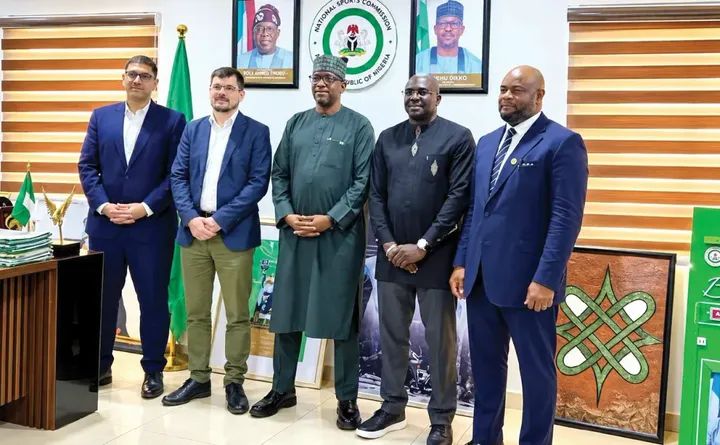
The leadership crisis in Nigerian football has taken a new turn as FIFA and CAF officials commenced a detailed assessment of the Nigeria Football Federation (NFF) crisis in Abuja, engaging government officials, federation stakeholders and members of the NFF Congress.
The joint mission is examining the events that led to the mass resignation of the NFF leadership and the implications for the federation’s governance and electoral arrangements.
NFF President Ibrahim Musa Gusau, General Secretary Mohammed Sanusi and several members of the Executive Committee resigned on August 27, leaving the federation facing uncertainty over its leadership and the planned electoral transition.
The FIFA-CAF delegation held an initial meeting with National Sports Commission Chairman Shehu Dikko, who briefed the officials on the government’s proposed reform agenda for Nigerian football. Members of the NFF Congress subsequently joined the discussions.
Among the officials participating in the mission are FIFA’s Ahmed Harraz, Rolf Tanner and El Hadj Wack Diop, alongside CAF Legal Manager Nnaemeka Olu.
Their assignment covers several sensitive areas, including the circumstances surrounding the resignations, the NFF statutes, the federation’s electoral process, the composition of its Congress, proposed governance reforms and the Federal Government’s involvement in football administration.
The assessment comes after FIFA and CAF suspended the NFF electoral process, effectively putting preparations for the September 27 Elective Congress on hold. The international bodies said the suspension would remain in place while they examine the legal, administrative, governance and electoral consequences of the developments.
FIFA has made it clear that the mission should not be interpreted as a decision already taken against the NFF.
According to the governing body, the assessment is intended to help FIFA and CAF “better understand the circumstances surrounding the recent developments within the NFF” and consider the views of stakeholders under the applicable regulatory frameworks.
FIFA also stated that any recommendations would only be considered after the assessment is completed, stressing that “the outcome of the assessment remains open.”
The intervention follows mounting concerns over the state of Nigerian football, including the failure of the Super Eagles and Super Falcons to qualify for their respective World Cups. The leadership crisis has added pressure for structural changes within the federation.
With the Abuja meetings now underway, attention is focused on whether FIFA and CAF will recommend changes to the NFF’s governance structure, electoral framework or leadership arrangements.
For Nigerian football, the outcome could determine how the federation moves from its current leadership vacuum towards a new and more stable administration.