



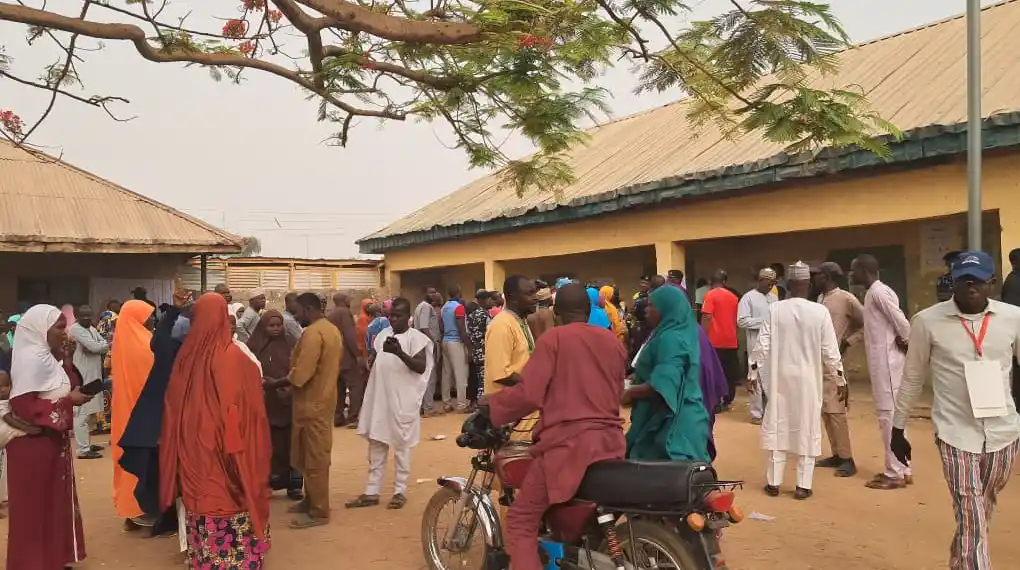
Agents of the Peoples Democratic Party (PDP) and the African Democratic Congress (ADC) have accused the ruling All Progressives Congress (APC) of attempting to financially induce voters at Polling Unit 035 in Nyanya during the ongoing Federal Capital Territory (FCT) Area Council election.
The allegation sparked tension at the polling unit as opposition agents publicly protested what they described as efforts by suspected APC intermediaries to distribute cash to voters.
According to an opposition agent who spoke to reporters at the scene on condition of anonymity, individuals approached voters on the queue and allegedly offered ₦1,000 in exchange for their support.
“Some people we suspect to be APC intermediaries came to speak with voters. They were giving ₦1,000, but we openly rejected and spoke against it. That was why the situation became unruly for a while, but calm was restored after they left,” the agent said.
Meanwhile, tension trailed voting at Kutunku I Primary School in Kutunku Ward, Gwagwalada Area Council of the Federal Capital Territory (FCT), after a voter alleged that agents of the Peoples Democratic Party (PDP) were offering cash inducements to sway voters.
The voter, who spoke openly at the polling unit, claimed that individuals linked to the PDP were distributing ₦2000 to voters in exchange for their support during the ongoing council election.
According to him, he personally received ₦5000 from a man he identified as Usman Nga’aha.
“I had no plan to do any election this year. But because of Usman Nga’aha and his people, they made me come here,” the voter said.
He added, “Usman Nga’aha gave me ₦5,000. If you vote for PDP, they will give you ₦2,000.”
When asked to clarify who gave him the money, he responded, “Usman Nga’aha. ₦5,000.”
Despite admitting to collecting the money, the voter insisted that his decision was not influenced by the cash. “I didn’t say I don’t need their money. I just like them. I just vote for them. I don’t need their money. I just vote. I get joy for them,” he said.
Vote-buying has remained a recurring issue in Nigerian elections, with civil society groups and observers repeatedly raising concerns about the monetisation of the electoral process, particularly at polling units in area council and local government elections.