



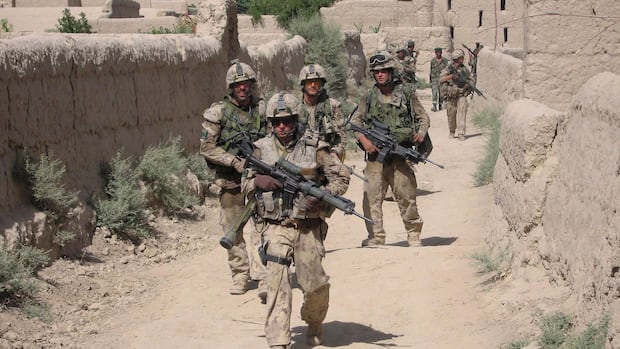
When Bruce Moncur was on the front lines in Afghanistan, there’s one name that was certainly absent among the Americans he fought alongside.
“I didn’t see anyone with the name tag ‘Trump’ … and I can almost guarantee, or I know for a fact, his sons were nowhere near the front line,” said Moncur, a retired corporal with Canada’s Armed Forces.
“So I guess people in glass houses shouldn’t throw stones.”
Those stones Moncur referred to are the recent comments by U.S. President Donald Trump about the contributions of NATO soldiers in general, and particularly, in Afghanistan.
“We’ve never needed them. We have never really asked anything of them,” Trump said in an interview with Fox News.
“You know, [NATO]’ll say they sent some troops to Afghanistan, or this or that. And they did — they stayed a little back, a little off the front lines.”
His comments provoked outrage from members of the NATO alliance, along with veterans of the Afghan war. Some have taken to Reddit, posting pictures of themselves in combat gear from their tours in Afghanistan, while cheekily describing themselves as “doing nothing.”
In October 2001, nearly a month after the Sept. 11 attacks, the U.S. led an international coalition in Afghanistan to destroy al-Qaeda, which had used the country as its base, and the group’s Taliban hosts. Washington had invoked Article 5 of the NATO treaty — calling for aid from its allies in response to the attacks on the U.S.
It was the first, and so far only, time a member had invoked the alliance’s mutual defence clause, obliging all member countries to come to the aid of another member whose sovereignty or territorial integrity might be under threat.
Hundreds of NATO troops were killed during the Afghan war. More than 40,000 Canadians served; the country’s largest deployment since the Second World War, according to Veterans Affairs Canada website.
While in Afghanistan, 158 Forces members, a diplomat, four aid workers, a government contractor and a journalist lost their lives. As well, thousands of other Forces members and civilians were also injured.
‘I was shot in the head’
Moncur was wounded in September 2006 during Operation Medusa — the largest battle fought by Canadian troops since the Korean War — in a friendly fire incident involving an American A-10 aircraft.
“I was shot in the head and I have a big scar thanks to that. And I felt the wind on my brains,” he said.
“Anybody that’s experienced that was nowhere near the back of the fight, [but] was up at the front.”
As for Trump’s comments, Moncur said he was “horrified” by the “awful, despicable statements by somebody who should frankly know better, specially given the position that he is in.”
But he also expressed concern that such comments could trigger other veterans still suffering from the war.
Michael Blois, a retired master corporal for the Forces who did two tours in Afghanistan, says he’s not surprised by Trump’s ignorance of NATO’s contribution, and that he shares the outrage and disgust many have expressed.
Blois was also wounded, caught in a blast in January 2007 from rocket-propelled grenades that resulted in a brain injury that affected his vision, hearing and led to some cognitive issues.

He says Trump’s words don’t diminish the accomplishments of NATO troops. But he says he’s concerned Americans will listen to statements like the president’s and won’t recognize the significant sacrifice that NATO countries, including Canada, took to come to the defence of the United States after 9/11.
“I’m quite proud of the fact that as a soldier in Canada, and a NATO member, we came to their call and fought on the front lines.”
Matthew Luloff, who served in the Princess Patricia’s Canadian Light Infantry from February 2008 until October 2008, says during his tour he lived in small combat outposts along the Argandab River and that most days began with an attack on the outposts.
“It was non-stop. Our patrols were constantly ambushed.”
Throughout his entire tour, his platoon was under attack and suffered casualties, he says.
He says Kandahar and Helmand were the most difficult provinces and that Canadians were in charge of Kandahar the entire time they were there.
“We were the troops on the ground. There was no one else there to bail us out,” he said. “I cannot imagine any other way to describe it other than being on or beyond the front line.”
Trump’s comments, he said, are hurtful, and besmirch the almost “unspeakable contribution that those that put their life on the line and lost it have done for this alliance, for their country and for the Americans.
“We didn’t go to war in Afghanistan because Canada was attacked. We went in defence of our allies and so many different partners came along with us. That’s what friends do.”