



The U.S. administration of Donald Trump is putting the lives of hundreds of political prisoners in Venezuela at risk by failing to prioritize their release in its transition plans for the country, says the mother of two brothers who’ve been imprisoned and tortured.
Marisela Parra, 49, said it brought her joy that the U.S. captured Venezuelan president Nicolás Maduro during a military strike on Saturday. However, the U.S. left the governing structure intact and Parra believes it still poses a grave threat to those who have been jailed for political reasons.
“The priority in this transition is oil and business, and then they talk about political prisoners,” said Parra, in a telephone interview with CBC News.
“How can there be a transition when there are … political prisoners, people who are tortured or who have been disappeared by the regime, while the regime continues?”
Venezuelan human rights organization Foro Penal says there are currently more than 800 political prisoners in Venezuela. The Venezuelan government released 54 political prisoners on Jan. 1, 2026, according to the organization.
U.S. Secretary of State Marco Rubio announced the U.S.’s three-step plan for Venezuela on Wednesday, which placed the release of political prisoners in a second phase, following the stabilization of the country, which includes selling off between 30 and 50 million barrels of Venezuela’s oil.

The Venezuelan government is currently led by Delcy Rodríguez, Maduro’s former vice-president, who was sworn in as president on Monday. Most of the other main players in the government remain in place, including Rodríguez’s brother Jorge Rodríguez, who is president of the National Assembly, Defence Minister Vladimir Padrino López and Interior Minister Diosdado Cabello.
All the levers of power, from the legislative branch to the courts to the military, remain under regime control.
“We know that Donald Trump is a businessman and it made me happy that he took the head [Maduro] away, but he left the cancer,” said Parra, who is currently in Colombia, but did not want to reveal her exact location, for security reasons.
One son punished for deeds of the other
Parra fled the country after facing threats following her youngest son’s defection from the National Guard in April 2019. Leandro Leomar Chirinos Parra’s unit was involved in helping free opposition leader Leopoldo López from house arrest. Leandro then went underground.
After his defection, Leandro, 31, was involved in an ill-fated May 2020 coup attempt against Maduro called Operation Gideon, which involved U.S. mercenaries. He was sentenced to 21 years in prison for his role in the foiled plot.

Marisela Parra said she lost touch with her son on Aug. 5, 2025, and hasn’t heard from him since.
“They’ve taken him and disappeared him,” she said.
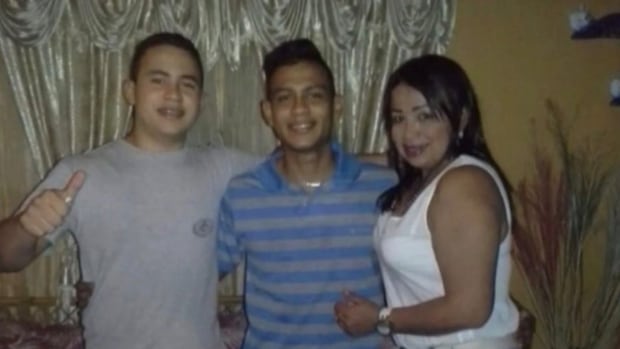
Parra said her eldest son, Leonardo David Chirinos Parra, 33, was punished by Venezuelan authorities for the actions of his younger brother.
Leonardo, a member of Venezuela’s counter-intelligence agency, was detained on April 20, 2020, and tortured to give up information on his younger brother, said Marisela Parra.
She said she lost touch with Leonardo for nine days until he contacted her via video call pleading with her to give up Leandro’s cell phone number.
“He said they were going to kill him and the rest of the family that remained [in the country],” she said.
Marisela Parra took screenshots of the video call and posted them online, and then lost all contact with her son for months.
The Inter-American Commission on Human Rights looked into the case at the time and determined that Leonardo Parra was “in a serious and urgent situation” and that his “rights to life and personal integrity” were “at risk of irreparable harm.”

Parra said her eldest son has faced torture while incarcerated, including electrocutions, beatings and that he’s been suffocated with a bag put over his head. She said her eldest son faced especially dire treatment while he was held in a prison at the Fuerte Guaicaipuro military installation, which is about 60 km south of the capital, Caracas.
She said the heat in the region is often extreme and prison guards forced inmates to dig and then stand in holes.
“They planted them like trees, standing there,” she said. “They would stay there until they managed to dig themselves out of the holes.”
Leonardo was transferred from Guaicaipuro about a year ago and is now in a prison called Yare III, which sits about 70 kilometres southeast of Caracas.
She last talked to her son in November 2024, because he isn’t allowed to place calls outside Venezuela. The family hasn’t heard from him since the U.S. attacks over the weekend.
“The story of my sons is something really tough, it’s very difficult and painful,” Parra said.
Wave of arrests followed 2024 election
Jesus Hermoso with the Committee for the Freedom of Social Activists said that within hours of the U.S. attack on Venezuela, his organization issued a statement saying the first act in any transition should be a general amnesty and the release of all political prisoners.
“The [regime] has intensified its repressive policy … We hoped that with this [U.S.] pressure, there would have been a significant loosening in matters of repression,” said Hermoso. “However, there is nothing that indicates that this is happening.”
Hermoso, who is a journalist, fled the country three months ago with his wife and two small children after he was told government authorities were looking to detain him. He said the head of the humanitarian organization where his wife worked was also recently arrested and imprisoned.
He said his organization has documented various cases of the use of sexual violence as torture by authorities inside Venezuela’s prisons.
“These are difficult cases to document, because many prisoners don’t want to denounce this after they are released,” said Hermoso. “Many prefer not to say anything or they ask that it’s kept secret.”
One of the last major waves of political imprisonment came following the July 28, 2024, election, which many observers determined was won by unity opposition presidential candidate Edmundo González.
According to Amnesty International, about 160 members of Vente Venezuela, the main opposition party, and 34 members of Primero Justicia, a smaller party, had been detained or disappeared by Venezuelan authorities by the end of 2024.

Luis Carrero, one of the top co-ordinators for the opposition campaign in the western state of Tachira, was one of those targeted, but he managed to escape.
Carrero said he was constantly under surveillance.
“They were always following us, the repressive forces of the state,” said Carrero, whose case was investigated by Human Rights Watch.
Carrero and his wife, who was also involved in the campaign, worked away from home for weeks at a time. But on July 27, 2024, the day before the vote, they returned home to grab some things in the early morning hours when five agents armed with assault rifles, and with their faces covered, stormed in.
“They hit my wife,” he said. “I tried to run, to alert my neighbours, but also to protect the information I had on my cellular phone. As head of the campaign [in Tachira], I had a lot of valuable information that I had not been able to erase.”
Carrero managed to toss his cell phone onto the roof of a neighbour’s house, but he froze when he heard a gunshot. They agents grabbed him and dragged him to his home. One of them found his cell phone.
“They said that if there was any chaos after the elections, that we would be responsible, that they knew where my family lived,” said Carrero, who now lives in Cucuta, Colombia.
The next day, Carrero and his wife went out and voted. They also helped collect the printed tallies produced by voting machines from polling stations across the state. The opposition collected more than 70 per cent of the tallies in the first 24 hours, and the results suggested a landslide win by González.
“Many of those [who worked on the campaign] paid with their lives. Many of them have paid with their liberty … for being part of the structure [that collected the tallies], for being witnesses in the electoral process, or for going out … to protest what happened, the theft of the will of Venezuelans,” said Carrero.
“It’s worth recognizing their struggle.”