



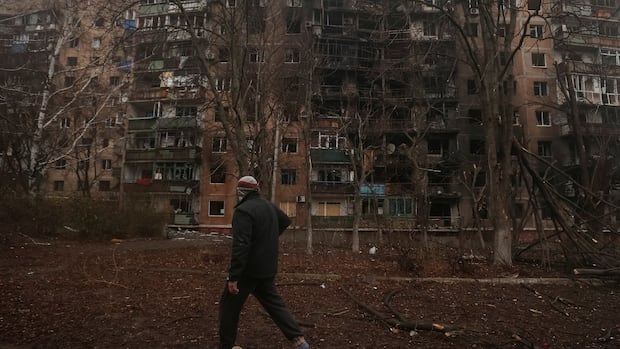
For nearly four years, the city of Kramatorsk in Ukraine’s eastern Donetsk has been a stronghold — a key logistics hub for the military, and for the population, a literal and symbolic fortress standing firm against a Russian push that continues to edge closer from the south and the east.
But under the Trump administration’s latest vision for peace, Ukraine would be forced to withdraw its troops from the city and the rest of the areas of Donetsk it still controls. Under the supposed compromise, the area would be turned into a special economic zone.
“It’s just absurd,” said Maksym Lysenko, an entrepreneur from Ukraine’s now-decimated city of Pokrovsk, who opened a store in Kramatorsk in the summer selling patriotic attire.
“People were dying, shedding their blood, and then what, just give up the territory?”
When Zelenskyy was asked last week about what kind of painful concessions Kyiv would be willing to have peace, he floated the idea of a referendum, saying it should be up to Ukrainians to decide.
Lysenko didn’t see the suggestion as a way to gauge public appetite for a deal, but viewed it as an attempt by Zelenskyy to placate U.S. President Donald Trump, who has repeatedly lashed out at him, calling him disrespectful and ungrateful.
“[Zelenskyy] simply said it not to annoy the U.S. president again,” said Lysenko. “He said, ‘OK you want a referendum; well, then, let’s have a referendum.'”

Pitching a vote
With Russian positions now less than 20 kilometres away from Kramatorsk’s boundaries, and with the city constantly under threat of drones and missiles, some of the tens of thousands of residents remaining are making the difficult decision to leave, even as the future of this city remains at the centre of the ongoing negotiations.
Meanwhile, Trump, hasty to make a deal, accused Zelenskyy of clinging to power and questioned how long Ukraine can remain a democracy if it doesn’t hold an election. In response, the Ukrainian president said the country was ready for an electoral vote, providing the U.S. and other allies provided security.
That suggestion is seen as again a way to try and politely push back against U.S. pressure to cede territory to Russia, turning any decision ultimately over to the Ukrainian public, who are very much against the idea.
Surveys have shown that while a majority of Ukrainians are in favour of a ceasefire agreement that would freeze the war along the front lines, three-quarters would not support a deal that would make major concessions. That includes withdrawing Ukrainian troops from the Donbas region.
“People are tired; people want peace. People are open to concessions, but not to surrender,” said Anton Hrushetskyi, executive director of the Kyiv International Institute for Sociology.
His organization regularly polls the public by phone throughout Ukrainian territory still controlled by Kyiv. The most recent survey was conducted between Nov. 26 and Dec. 13 and included 547 respondents.
Polling the public
Hrushetskyi told CBC News in an interview by Zoom that it has been difficult to formulate questions to gauge public support around a prospective peace deal, because it’s unclear what’s actually on the table.
Even so, he says the results from the most recent survey showed Ukrainians were ready to “endure the war for as long as it takes to achieve some decent conditions” for peace.
He says this kind of attitude has remained dominant throughout the war, but what has changed is the level of trust in the U.S. Just 21 per cent of Ukrainians trust Washington, a drop down from 41 per cent at the same time last year.

Hrushetskyi says Zelenskyy’s idea of referendum was “some kind of show” to the U.S. that Ukraine is acting on Trump’s demands, actually carrying it out would be logistically difficult, as it would first require a ceasefire, which Russia has already repeatedly rejected.
Russia also rejected the proposal for a referendum. On Dec. 12, Yuri Ushakov, a foreign policy adviser to Putin, claimed there couldn’t be a vote, because “the area is Russian territory,” referring to the rest of the Donbas.
Increased support for negotiations
However, Mikhail Alexseev, a political science professor at San Diego State University, thinks the idea is feasible. He says the referendum could be partially carried out by phone or online for remote areas.
However, he believes Ukrainians would be overwhelmingly against any plan that would require the country to hand over the rest of the Donbas.
“I think that if a referendum took place today, they would not accept at all the kind of proposals that Putin put forward,” he said.
A 28-point roadmap that was drafted by the U.S. and Russia and leaked last month was criticized by Ukraine and its European allies as being a Moscow wish list that would see Kyiv give up territory, reduce the size of its military and abandon its NATO ambitions in return for security guarantees.

Ukraine has said it is willing to drop its goal of joining NATO, and that there has been real progress on drafting strong security guarantees, but the issue of territory remains the most difficult.
Alexseev has been conducting joint research with the Ukrainian National Academy of Sciences for nearly 10 years, and has been polling a group of hundreds of Ukrainians since 2021.
He told CBC News in an interview by Zoom that there has been “considerable softening on the territorial question” and that the flurry of diplomatic meetings, which intensified over the summer, has increased support among Ukrainians for some kind of negotiated settlement.
But he says at best, the talk is around partial concessions.
“Zelenskyy is actually probably more conciliatory than the Ukrainian society is on these matters because he understands diplomacy,” he said.
“He understands the importance of relations and the importance of military assistance and a lot of political issues associated with it.”
He says for the Ukrainian public, anything that seems like capitulation would be “unconscionable.”
More residents leaving
Back in Kramatorsk, Lysenko says over the past month, more residents have been leaving the city, because in November Ukraine suspended railway service to the front-line community over security concerns.
He opened his store in the summer, with shelves stocked with shirts that read, “The sun will rise over a free Donbas.”
WATCH | What Ukraine wants:

Ukrainian negotiators are meeting with U.S. officials in Florida to discuss details of Washington’s proposed framework to end Russia’s war in Ukraine, as Kyiv faces pressure on military and political fronts. Ukrainian MP Halyna Yanchenko tells Rosemary Barton Live what she hopes will be different about these talks compared to previous negotiations.
He has no immediate plans to leave, but is making arrangements for some of his staff members to relocate to Kyiv because of “the dangerous situation.”
After nearly four years of war, he says everyone wants it to end, but he believes giving up territory is not a step to peace.
“Russia wants all of Ukraine,” he said. “Even if Donetsk was surrendered completely, in two or three years, we will have a new war.”