



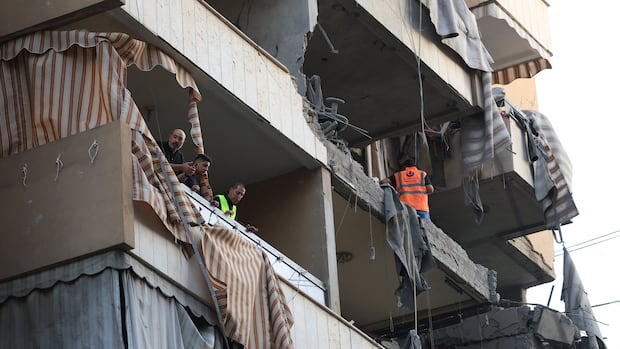
Israel carried out an airstrike on a southern Beirut suburb on Sunday targeting a senior official of the militant group Hezbollah, despite a ceasefire between the two sides brokered by the United States a year ago.
Prime Minister Benjamin Netanyahu said the strike, the first on Beirut in months, targeted the Iran-aligned Lebanese group’s chief of staff. An Israeli source briefed on the strike and a Lebanese source said Hezbollah’s Ali Tabtabai was the target.
The United States imposed sanctions on Tabtabai in 2016, identifying him as a key Hezbollah leader and offering a reward of up to $5 million for information on him.
At least four people were killed in the strike that also injured two dozen, who were taken to nearby hospitals, medical sources said. There was no immediate comment from Hezbollah.
It was not immediately clear if Tabtabai was killed.

Hezbollah said the strike, launched almost exactly a year after a ceasefire ended that Israel-Hezbollah war, threatened an escalation of attacks — just days before Pope Leo XIV is scheduled to visit Lebanon on his first foreign trip.
Mahmoud Qamati, deputy chair of Hezbollah’s political council, told journalists that a high-ranking militant may have been killed but did not give details.
“Hezbollah’s leadership is studying the matter of response and will take the appropriate decision,” Qamati said at the site of the attack. “The strike on the southern suburbs today opens the door to an escalation of assaults all over Lebanon.”
Strike hits main road
Following the strike, Lebanese President Joseph Aoun urged the international community to intervene to halt Israeli attacks and prevent a further deterioration of the security situation.
Israel has carried out near-daily strikes on Lebanon since the ceasefire came into effect in November 2024, targeting what it says are Hezbollah arms depots, efforts by the group to rebuild and individual fighters. But targeted strikes on senior officials like Tabtabai have been rare.
The strike hit a main road in the Haret Hreik suburb, where residents told Reuters they heard the roar of war planes before the blast.
People rushed out of their apartment buildings out of fear there would be further strikes, a Reuters reporter there said.

Israel says it won’t allow Hezbollah to rebuild
“Israel continues to insist on the full enforcement of the ceasefire agreements with Lebanon while taking steps to ensure our security,” Israeli government spokesperson Shosh Bedrosian told reporters after the strike.
“We will not allow Hezbollah, the terror organization, to recover and rebuild its strength and threaten Israel from anywhere inside of Lebanon.”
Asked if Israel had notified the U.S. before carrying out the strike, Bedrosian said Israel acts independently.
Over the past two years, Israel has killed Hezbollah leader Hassan Nasrallah, much of the group’s senior military leadership and roughly 5,000 of its fighters. Israel has said the strikes were necessary to protect itself from Hezbollah attacks.
The militant group has over the past year accused Israel of repeatedly violating the ceasefire that the U.S. mediated.
Under the ceasefire, Hezbollah is required to end its military presence in the southern border region near Israel, and Israel’s military is supposed to withdraw from Lebanon.
Israel, whose soldiers are still occupying five southern posts in Lebanon, accuses Hezbollah of trying to regroup there. Hezbollah has said it is abiding by the ceasefire. It has not fired on Israel since the ceasefire started.
In November, Israel stepped up airstrikes in south Lebanon as it pressed a campaign of near-daily attacks which it says is designed to block a military revival by Hezbollah in the border area.